Tuesday, 5 May 2020

Generic Research: Forming First Ideas

In order to organise my thoughts and choose a song, I decided to make some notes on three songs that I was considering using for my media coursework.

You Are the Problem Here - First Aid Kit
Narrative
- Opening wide shot of a band readying themselves to play on a stage without the music. Cuts to shots of the bar they're performing at with a majority older male audience sitting in pairs and threes and talking. At the bar, there is a woman sitting in a red dress with a glass of Coca Cola and the bottle next to it.
- The main singer walks on stage wearing a t-shirt, jeans and a black, wide-brimmed hat. She looks up and the camera cuts back to the girl at the bar who gives her double thumbs up. Cuts back to the singer who smiles at her straighten her microphone and the room goes quiet.
- Close-up shot of the singer's mouth with red lipstick near the microphone as she sings opening lyrics.
- An older man walks up to the girl at the bar and starts speaking to her which she brushes off in favour of listening to the music
- With the line "From some man's sweaty, desperate touch", the man runs his hand along her waist/up her thigh and the camera follows the movement in a close-up before cutting to the woman's face visually uncomfortable.
- Singer gets off the stage and begins to fight the man in tracking motion before it cuts to the same band busking on the street.
- A similar scenario occurs and a man touches a woman inappropriately and the singer of the band does the same thing - leaves the band (still singing the lyrics) to help the woman.
- For the chorus, the camera cuts between the band performing and the singer in a fight with the men whilst singing the lyrics.
- Second verse cuts to the band walking through a group of women with signs saying 'Women's rights', 'No means No', 'My body my choice', etc. with closeups of the band for audience gratification.
- Bridge with "Sisters or daughters or mothers" cuts to mid shots of lots of women of different ages, ethnicities, sexualities, etc.
- Chorus again is the band performing and women protesting with their signs with close-ups of women shouting and of their signs.
- The final line of the song "And I hope you fucking suffer" is a close-up of the singer looking down at the man back in the bar holding the girl from the bar's hand and mouthing the lyrics.
Location
- Smallish Pub - Fatty's Bar, Hadleigh
- Southend High Street at Night
- London Oxford Street
Actors
Singer
2+ Band members
15+ women of different ages, ethnicities, etc.
5+ middle-aged men
Colour Palette and Mise-en-Scene
- Use a range of darker colours like reds and dark yellows to connote rage and reflects a darker mood in the video.
- Shoot colours from beneath the actors to cast shadows to create an imposing atmosphere that can be seen as accusative.
- Give the sense of poor lighting on the street to suggests that sexual assault happens in everyday life as well.
- Want the mise-en-scene to reflect how, although the band are small (playing in small pubs/busking) they sing about pertinent issues that affect people in life all the time and how things won't stop unless we make a change.
Camera and Editing
- Range of close shots used to fulfil Andrew Goodwin's idea of gratifying the audience with shots of the artists
- Tracking shots of the artist moving and also whilst playing their instruments and these shots also give the audience a perspective, as though they're following along with the narrative too - makes it more personal
- Want the shots to change on the beat with the song and be a couple of seconds long to match the song which isn't fast-paced - therefore the editing shouldn't be fast-paced either
Pros
- Would be extremely powerful.
- Could raise awareness of sexual assault and rape.
Cons
- Would be extremely difficult to get the right characters for the role and I don't know enough people to play them.
- Would need to get permission from a pub to film in and, being under 18, this may be difficult.
- Requires a lot of moving about and would take a long time to film.

Girl with One Eye - Florence and the Machine
Narrative:
- Opening shots are of women walking along, some paired, some solitary before cutting to the singer standing against a wall with a suit on and a drawn-on moustache.
- The singer begins lip-syncing the song, walking along, cutting down to her feet skipping along the pavement, avoiding the cracks, as said in the lyrics.
- Scene changes to the singer pushing a woman against a wall in an alley hounding her and mouths the words "Not to fuss and relax" with "relax" being zoomed in on her mouth
- Cuts back to singer walking along and suddenly comes to a halt I time with the lyrics with her hands up. However, a woman walks past and the singer follows her with her head, despite having 'stopped'.
- Cuts to the woman from the alley in bed on her back and she turns to switch off the light
- Back to the singer walking down the street who takes a flower from a woman sitting on a bench before she crushes it with her hand.
- Drags her finger across her neck for 'Slip her a smile' and smiles at the camera.
- Cuts to the woman from the alley in bed on her side with her eye wide open before she rolls over.
- Pushing up girl against the wall mouthing the lyrics and on 'cry' the singer puts her hand over the other girl's mouth.
- Low angled close-up of a hand rising up the girls skirt and a closeup of lips mouth 'Don't worry, it's not gonna hurt'.
- Girl's face is fearful and her makeup has run cause she's scared and crying.
- Cuts to victim closing her front door before sliding down it and sobbing into her hands.
- Repeats the assault by the singer but the girl pushes her and begins to mouth the lyrics herself with 'Hey' and 'Get your filthy fingers out of my pie'.
- Close-up of the girl near the singers mouthing the lyrics and on the 'cry' the camera moves fast in a circle and cuts to 10+ women in a park with protest shouting 'You made me cry' with that on some of their signs.
- The breath cuts back to a close-up of the singer on the street, slightly dishevelled and it zooms out as she staggers along, not singing the lyrics any more.
- Falls onto her knees and when she looks up, she's in the park with the protesting women around the singer, singing the lyrics.
- The final lyric 'cry' is said with an ariel shot of the singer as the women walk away with their fists raised and their signs aloft.
Location
- Rayleigh High Street
- Alley in Hadleigh
- Bedroom
-St George's Park/John Burrow's Park
Actors
- Singer
- Girl from the alley
- Approx. 10 extras
Colour Palette and Mise-en-scene
- Bright colour palette for street scenes to represent the idea that abusers walk free and around us every day with the singer wearing a suit and a drawn-on moustache to symbolise the idea of men sexually assaulting women.
- Dark red colour palette for alley scenes with the woman wearing white, symbolic of purity and as though the abuser is going to take that from her.
- Dark blue colour palette for the victim in her bedroom as she reflects over the horrors she suffered
- Bright colour palette for the protests suggests that there is light in a dark world
Camera and Editing
- Range of close shots used to fulfil Andrew Goodwin's idea of gratifying the audience with shots of the artists and fulfils the performance aspect
- Tracking shots of the artist moving and also whilst playing their instruments and these shots also give the audience a perspective, as though they're following along with the narrative too - makes it more personal
Pros
- Not too difficult to make.
- Sends an impactful message.
Cons
- Difficult due to COVID-19

Exit Music for a Film - Radiohead
Narrative
- First chords are close-up shots of around a teenaged-girls room of family pictures, a picture of the virgin mary, a catholic cross, etc.
- The first line "Wake" is a birds-eye view shot of a teenaged girl in bed and, when the line is sung, she opens her eyes and begins to get out of bed.
- She wipes her face with her hands and reaches a hand down the back of her bed and draws out a bag/purse with "ESCAPE" painted in red letters on it. and cuts between close-ups of her face and drawn out wide shots of her in her room.
- With the next lines, she begins packing a bag and getting dressed into a conservative outfit that covers a lot of her and then continues packing the bag, throwing covert glances to the door.
- Cuts to a symbolic paintin' of hell/devil and cuts to a low shot of the 'father' sitting on the sofa in the living room with a bottle of beer. 
- The girl glances towards her father before leaving and getting on train/in a car and meets a friend, they hug.
- Cuts between close-ups of the girl looking out of the window, breathing and her changing into a rainbow outfit and pulling a pride flag out of her bag and laying it on her lap, smiling.
- Shots of the girl and her friend at a pride festival, laughing talking, shots of the parade
- Looks up and the camera follows her to look at the other girl and they smile at one another and when "Alone" is sung, they hold hands.
- Short quick shots of protest signs with intertextual references to famous songs/movies but against LGBT and someone runs at the main girl to hit her and the screen turns black
- The shot is of the girl curled up and she stands up and the camera follows her and she has SFX makeup of bruises and blood on her head and running from her nose, her pride flag over her shoulders.
- She begins to walk and the camera moves back as she moves forwards with a  determined look on her face. She wipes away the blood from her nose with her fist and walks through a big crowd of people/down an empty street.
- When the music rises ("Now/ We are one") the shot cuts back and forwards between her walking and her and her girlfriend kissing, touching, holding hands and being intimate as a lesbian couple in love. 
- There are also shots of her father yelling at her pointing at pictures of the gay couple together whilst she shouts back - he goes to hit her before it cuts back to her walking down the street.
- The final line is her opening the front door to her house and her father standing there. She takes a deep breath, opens her mouth and the video cuts to black.
Location
- Girl's house: Bedroom, Living room (Bathroom potentially?)
- Train/Car/Bus
- London Pride
- Oxford Street
- Neal's Yard
Actors
- Main Female character who matches the target audience
- Father
- Girlfriend
Colour Palette and Mise-en-scene
- Neutral colours used for the house scenes as there isn't really anything too special going on
- Brighter colours when filming in Neal's Yard and at Prides with saturated reds and yellows to create a warmer colour palette
- When the music changes, the colour palette becomes cooler with blues and greys in order to create a sombre effect.
- Want the mise-en-scene to reflect issues that the audience will both understand and may be able to relate to. The use of young people reflects the audience and, by filming it at Pride, it requires a certain cultural/social awareness.
Camera and Editing
- Range of different shots from both low and high angles to create a perspective for the audience.
- By using a continuous tracking shot, it allows the audience to feel like they themselves are walking with the character.
- Want the camera to build up a crescendo so the video clips may get shorter to create more tension in the video.
Pros
- Is an important topic for the target audience with a large percentage of young people identifying as LGBT.
- Would be easy for the primary target audience to relate to LGBT themes and the idea of standing up for what you believe in.
Cons
- May be difficult to do due to COVID-19 and Pride Parades being cancel

Monday, 4 May 2020

Generic Research: Textual Analysis 3 (Music Video)

King Princess, another singer who has only recently come into the spotlight, is an LGBT singer who's androgenous style has reached big headlines. When her career kicked off with her hit single 'Cheap Queen', King Princess portrayed herself as a genderless winner in the music video and it had an extremely positive review. She has found herself within the midst of fashion scandals due to her more unique and androgenous style that separates her from the crowd, as well as not shaving her body hair, to make a statement to women that you can live in your body however you want to. Not only is she an advocate for LGBT rights, but she also speaks out for female body empowerment and, despite her young age, but she has also made herself a name.
Her music video for 1950 overall has a homemade feel to it with shaking cameras depicting a lesbian couple just being in love casually. As well as this, however, there are elements of performance throughout the video with a  band playing whilst King Princess sings. This lipsyncing idea integrated into the video is something I wish to emulate with my video for my coursework as it gives the narrative a broken up feel, which can create a sense of the passage of time. I especially enjoyed the use of the band on a stage, as though performing at a party and feel this idea may also work well in my own, allowing for the narrative to progress easily.
1950 is a performance-narrative music video with a shallow meaning but the video is visually aesthetic to help carry the lyrics. I feel the integrated performance aspect is what I wish to emulate from this video and to adhere to Andrew Goodwin's theory of music videos.

Thursday, 30 April 2020

Generic Research: Textual Analysis 2 (Music Video)

Hayley Kiyoko, despite only finding fame recently, quickly made a name for herself amongst the LGBT community. As a lesbian, Kiyoko's music circulates around attraction to women and young girls finding innocent love too, just like other videos would do with straight relationships. She speaks out in a lot of interviews for same-sex relationships to be normalised, especially with younger people as it allows them to discover themselves without having to deal with the hardships. 
I personally wanted to take a lot of influence from the specific video clip, especially the innocent love between girls. Another feature I wish to include is the peaceful serenity leading up to a crescendo such as in the music video where the girl gets hurt on a rock and beats up the boy. I feel like this creates a more impactful scene and that it can create more emotion in the video.
From this music video, I enjoyed the narrative that was created and this idea was what I wanted to emulate within my own video with the idea of innocent teenage love against a world that didn't support it. I also liked the normalisation of the girls' love together and how their friendship could also have been their love as it was so easy to slip into. Their care for one another is clear through the video and it is something I wish to represent through my own.
Girls Like Girls is a simple narrative music video, nowhere near as in-depth as Daydreaming, however, I enjoy the simplicity and the narrative is the influence I wish to take from this video. With my own, I want to recreate this women-loving-women relationship that the main characters have whilst including elements of protesting against family life and against those who do not support the young love. 

Monday, 27 April 2020

Generic Research: Textual Analysis 1 (Music Video)

The song I decided to use for my media coursework is a Radiohead piece and the band itself have been able to create one of the biggest names for themselves in both audio and visual history. Their music is used in television purposefully, with each individual song giving a different meaning. This idea is said to be called the Radiohead Effect, the use of Radiohead music used to make the audience think and to form ideas around what effect this is supposed to have.
Only a handful of bands actually can command attention and analysis when their songs are played in a movie scene and Radiohead is one of these very few. Despite two of their members being successful film composers, their original music made by the band itself can be used to shape meaning and impact onto scenes in films.
Radiohead's genre of music is difficult to define as it weaves in and out of genres, however, it is distant yet has a sense of comfort too. Most importantly, Radiohead's music makes people think. The amount of effort put into a singular song is obvious when listening to their tracks and when one of their songs is used in a film, the thought that was originally put into the song itself, come through onto the film as well.
With my own music video, I wanted to create something in the style of Radiohead as I admire their artistic style. The first video I took inspiration from was Daydreaming.
The Longer continuous shots were what inspired me from this music video. When the camera followed Thom Yorke, it gave the sensation that you, as the audience, were following him on his journey. That is something I wish to recreate in my own music video, to create a sense of fluidity and narrative in the video. Although there is an eerie, dreamlike atmosphere, the expression Yorke has suggested a sense of serenity that you feel in a dream and I wish to recreate this idea of bliss in parts of my own music video. Radiohead is known for making surreal and intricate music videos which is why their music is so popular as there are hidden depths within the visuals that you must dig deeper to find.
The continued use of intertextual references is used in order to allow the audience to feel a certain sense of gratification of being able to spot certain aspects of the video and relate them to outside references. 
Daydreaming is one of the most intricate music videos I have seen and the amount of intertextuality isn't something I can emulate, however, it is something I liked to take inspiration from and use small references in my own video, in the backgrounds for active fans of the band to find.  As well as this, the use of continuous shots is also something I would like to include as I feel as though it gives a sense of the audience moving along with the characters and actually being present in the narrative. It allows for the audience to invest themselves more with the character.

Wednesday, 22 April 2020

Audience Research: Focus Group

A focus group are a group of people assembled to talk about a product before it is released. In this sense, I gathered a group of 4 people, 2 of which are the intended primary audience and the other 2 are the secondary audience. This allows me to grasp the range of opinions but also to apply my product to more people. All 4 participants fit into the target audience of the brief being a socially conscious 16-24 middle to upmarket demographic. My personal primary audience is to members of the LGBTQ+ community as well, with my secondary audience being those who support. 
By creating a focus group, my audience can directly give me their thoughts and opinions and I can more directly adhere to the interests of my audience.

Lillith Freeman - Primary Audience
Lillith is an 18-year old student who attends Sixth Form and is in her final year. She falls into the primary audience category and is a member of the LGBT community and a young public speaker for women's rights and environmental activists. She studies English Literature, Drama and History and enjoys theatre, art, history and literature.
What psychographics do you fall into?
Mainly just reformer.
What is your favourite song and why?
Michael by Franz Ferdinand. This song just makes me feel free; it's fun and feisty but has a rawness to it. It's about fluid sexuality, and the way its represented in this song is something that is really important to me.
Who is your favourite artist and why?
Hayley Williams (as a solo artist, not her band). Her songs feel like works of art. They have beautiful lyrics and her use of sound is interesting and exciting.
What's your favourite music video and why?
My Life is a Song for You by Tom Rosenthal. It is made by a filmmaker that I love, Bertie Gilbert, and I like it particularly because it is just so real. It isn't just a music video, it is a documentary on people's losses and their artistic responses to that, and I think it's just really special.
What is your favourite music streaming service and why?
Probably Spotify because it's free and easy to use. I can cope with the ads!
Do you go to concerts and festivals and why?
Not very often but I have been to some. They tend to be too expensive for me to afford.
Do you use social media and, if so, which?
Instagram, Facebook and WhatsApp.

Ash Bournes - Primary Audience
Gender Identity: What It Means to Be Gender Fluid and Non Binary ...
Ash Bournes is a 19-year-old, gender-neutral member of the LGBT community, currently in their first year of university studying Bio-Chem. Their main interests, besides science, are photography and film-making, including working the cameras for costume design shoots. They also play the guitar and hope one day to perform too.
What psychographics do you fall into?
Probably a reformer, I'm pretty socially aware.
What is your favourite song and why?
See Through by CAMINO because it's really easy to sing and play along to.
Who is your favourite artist and why?
Years and Years I think because they not only play good music but also have a great message of LGBT representation in their music.
What's your favourite music video and why?
Young Volcanos by Fall Out Boy is definitely my favourite by far! It's got this really creepy imagery and it contrasts the song which is super upbeat and almost cute.
What is your favourite music streaming service and why?
Easily Spotify. My whole family have this bundle deal, it's so easy to access and practically everyone's using it so you can find practically any song you want on it.
Do you go to concerts and festivals and why?
If I can, I'm pretty skint at the moment. It's a great atmosphere and being around other fans is awesome too. It gives a different experience than sitting listening to it through your headphones and is just great to see the artists performing live. But right now I can't go and see any one cause, being a uni student makes it hard; it can be expensive and inconvenient to get to.
Do you use social media and, if so, which?
Yeah, I use pretty much all of them! Instagram, Snapchat, Youtube, Tumblr and Discord. I stay far away from Facebook though!

Henry Bird - Secondary Audience
boy, brunette, grunge, guy, hot, pale, selfie, site model ...
Henry is a 16-year-old student, studying his GCSEs at his final year of secondary school. He studies art and music and hopes to go on to continue them at Alevel too. He enjoys keeping fit alongside his passions for art and music and spends the majority of his time playing videogames and listening to most of Spotify.
What psychographics do you fall into?
Strugglers and reformers I guess
What is your favourite song and why?
I can't pick one! Probably The Mint by Earl Sweatshirt, Stoned Again by King Krule and Guest House by The Daughters but there's so many more. They're all perfect in pretty much every way: lyricism, instrumentals, themes, you name it.
Who is your favourite artist and why?
It was a throw up between Kendrick Lamar and Radiohead but I have to go with Kendrick. He is, without a doubt, the greatest lyricist of our time, very possibly of all time.
What's your favourite music video and why?
Ain't It Funny by Danny Brown. It's an extremely introspective piece about the pitfalls of our society in how we alienate and mistreat drug users and how everyone sees it as so 'funny' that people, Danny Brown included, are doing real damage to themselves and are unwilling to help. I would suggest it highly to anyone who wants to learn about the subject and what real people re going through. The music itself is very inaccessible to most listeners but the use incredible lyrics and a mix chaotic, experimental jazz and rap make it an unforgettable experience.
What is your favourite music streaming service and why?
I use Spotify, YouTube and Apple Music but I tend to use Spotify more. However, I use each other for when the other doesn't have a particular thing, etc.
Do you go to concerts and festivals and why?
Yeah, I go to concerts and stuff because I am a lover of music. There's no real experience like going to see music live. It's a good way to support artists since streaming services typically are very bad for it.
Do you use social media and, if so, which?
I use Reddit and Youtube. Occasionally WhatsApp to catch up with friends.

Lientho Barclay - Secondary Audience 
Lientho, aged 23, is currently studying medicine at the University of Birmingham. When not studying, he enjoys doing sport, music and art in his spare time and enjoys taking interest in his friends' studies too such as in politics and history; he enjoys debating with friends on topical stories. 
What psychographics do you fall into?
Most dominantly succeeder but also reformer and aspirer. I want to win and be the leader in my ideal world.
What is your favourite song and why?
Winner Circle by Anderson Paak, it's such a good mix of all the human emotions I value.
Who is your favourite artist and why?
It's my favourite song so he's also my favourite artist. Anderson Paak is just a versatile chill guy.
What's your favourite music video and why?
Shackles by Mary Mary, a bit of a throwback! It's a glorified memory from my childhood so it's something I remember fondly.
What is your favourite music streaming service and why?
Spotify, it just has everything I want on it.
Do you go to concerts and festivals and why?
No, I've never been to one but I plan to. Just need to get enough money to go.
Do you use social media and, if so, which?
Yeah, I use Instagram, WhatsApp, Discord and Snapchat.

Monday, 20 April 2020

Audience Research: Feedback on Pitch

In order to understand what my audience wanted from my music video, I created two questionnaires to ask my audience what they thought of my general idea for my product. I had an array of answers. 

My first question was asking if they believed my pitch fit the brief for the music videos and everybody who took the test said they thought so, which was a good start.
I next asked them if they had listened to the music I wanted to do for my music video and instructed them to do so if not. I felt that if they had heard the song, that would have a better understanding of what I was trying to achieve through my music video.
I also asked if they believed it could create an emotional video as that was the kind of genre I was hoping to go for. I feel as though a protest video is quite difficult to make positive without there being some kind of emotion behind it as well.
I next asked if people thought that this video would be appropriate as a protest song. I actually had three people say no and, in question 6, they go on to say that they feel it would be TOO emotional and not be able to be enjoyed by the intended audience. However, despite this, I disagree with popular music videos having dark and emotional videos which gain a lot of popularity from a younger audience and I believe that despite these peoples votes, my music video would be popular.
 When I asked an open question to whether my pitch would appeal to the audience, the answers were all very similar and believed that LGBT rights are very prevalent in the media at the moment and that therefore, this would be a successful video. Younger people are more likely to be able to relate to the LGBT themes in the music video due to there being approximately 52.8 million people in the UK aged between 16-24 who identify as LGB (2017).
I then asked the people doing the questionnaire if it appealed to them as the target audience. Most people said it did as it tackled prevalent social issues in society which are modern and perhaps relatable for some of the target audience. However, others said that the sombre mood and tone of the video may not appeal to everyone and that, in order to combat this, I would have to produce some lighthearted scenes as well which I intend on doing now, thanks to this feedback.
My final question was simply asking for suggestions and people were worried about the use of a Pride Parade due to COVID-19 and I too am also worried. Due to this, I have come up with a backup plan that I'd use if I wasn't able to shoot the video I wanted to.
By reading the responses to my questionnaire, I felt more confident in my revised idea and made sure to take everyone's comments into consideration.

However, I also made a second questionnaire which covered the entirety of music videos in a broader way which I shared with 30 people from the target audience and received answers that helped direct my research for music videos a bit more precisely.

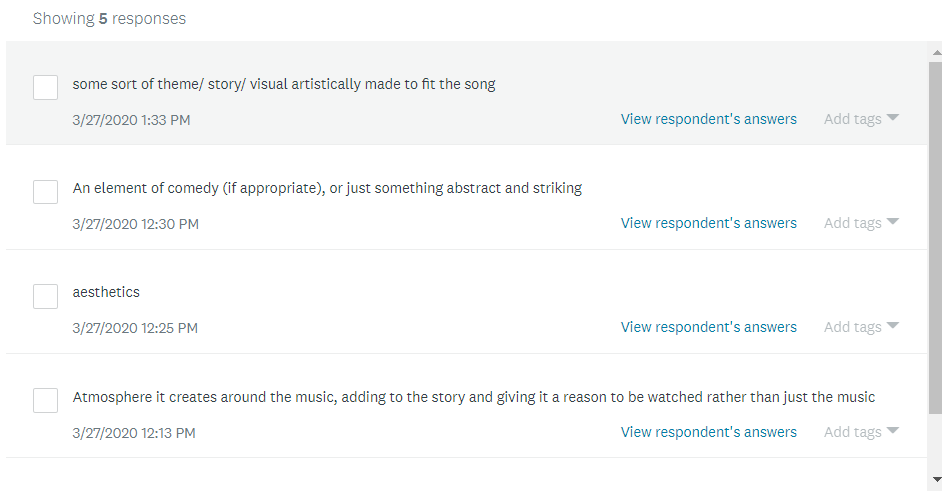
I first asked what people liked about music videos. The majority said they preferred a story-line based music video which was excellent for me as that was what I intended doing and told me that this meant that my intended audience enjoyed an aspect of narrative to music videos. As well as this, a lot of people also said they liked artist and instrument performance. Unfortunately, I hadn't planned for this and wasn't thinking of including the band in the video at all, but, since the audience showed interest, I decided to try to include short clips of the band's performance.
 I also added an 'other' box which allowed people to add different points that I hadn't made options and of which the majority said aesthetic. Due to this, I've decided to use this idea in my music video and I feel by saturating colours and giving the footage contrast, this could help appease those who enjoy aesthetics.
 I then asked people if they liked videos that have a deeper meaning. I was surprised at the answer as the majority said that they did (Yes was 0, No was 100). This suggested to me to try to include deeper messages in the video for an active audience to try and figure out which could give them a sense of gratification.
 When asking how often people watched music videos, I wanted to get a general idea on how often the target audience engaged with the media type I chose however, I realised this was a foolish idea as the responses were extremely varied.
 I was expecting the answer I received with this question as many people choose to watch music videos from the music they already like. Therefore, this was simply to grasp an idea on how to address the audience when I start to make my website. I feel like being friendly and personal with the audience is more popular than presenting a website that is simply there to give information; interesting with audiences is important to keep them entertained.
 Again, like in the first questionnaire, I asked if people had heard the song I wanted to use, in order for them to have it in mind when answering the rest of the questionnaire.
 With this question, I was trying to see if people like it when the lyrics reflect the visuals because it creates a sense of gratification. Also, to fans of the song who know the lyrics, it'd be easier to spot certain features. A lot of people also said that it didn't matter, however, a single person said that they didn't like it and, looking through the rest of their responses, I believe this is due to the fact that they prefer the artistic aspects of music videos rather than being relative to the lyrics.
 This question was simply to gauge my audiences music taste and to see the range of music that people listen to if they had to pick a singular genre.
 I was surprised by this response and believe that actually many people may have watched a protest music video without knowing it. For example, Lady Gaga's video 'Born this Way' is a protest against homophobia and transphobia saying that people are simply who they are
I asked this question as I felt it was important to know whether people enjoyed more light-hearted videos with lighter themes or did, in fact, enjoy a deeper storyline. A couple of the participants messaged me after they completed the questionnaire and told me the reason they said no is because they feel important issues shouldn't be forced into the video and that, if they work, they should be used, not simply to make the video seem like it relates when it doesn't.
This final question was simply to find out which platform would suit my music video best and easily helped me decide. It also is going to help me when designing my website and knowing which platforms to include/not include.

These responses were incredibly helpful as they helped me hone done on some certain aspects of my media coursework and aided me in making decisions. 

Tuesday, 7 April 2020

Generic Research: Analysis of other protest music videos

In order to capture the true essence of protest music videos, I first watched a few and analysed them, trying to understand what sets protest music videos apart from others.

1. Freedom is Free by Chicano Batman

https://www.youtube.com/watch?v=mkEmnrUzFFE
The idea that freedom isn't free has been the ideological fuel behind America's hyper-militarization for a long time. But Chicano Batman challenges this idea on the funk-soul song Freedom is Free by singing, "You've got your guns up on display/ But you can't control how I feel no way/ 'Cause freedom is free." The music video is a dramatic contrast to the lyrics with a brutally visceral twist to the message: the members are being tortured by waterboarding, a torture technique used by the US military on multiple occasions.

2. Now by Miguel
https://www.youtube.com/watch?v=6eFL1zzGK8o
The Mexican/African-American singer Miguel uses his music video Now to she light on immigration detention centres on the last song of his album 'War and Leisure'. In the music video, he's performing at a #SchoolsNot Prisons rally near Adelanto High Desert Detention Centre which is home to over 2,000 detainees from Latin America. There are protestors show holding signs that have crossed out the words 'detention centre' and are replaced with 'prisons' in red ink. The lyrics and visuals also correspond with one another with the lyrics calling out Donald Trump's xenophobic policies towards immigrants with lines "CEO of the free world now/ Should we teach our children hatred?"

3. Fight Like a Girl by Zolita
Both the song and the music video are very female-empowering which is especially addressed with the now infamous line "My body my choice/ My rights and my voice" but adding "Can't grab me by the..." which is a direct reference to Trump's comments about women. The singer tries to dismantle the patriarchy with a girl-cult who all wear red lingerie to embody power but perhaps also a reference to menstruation and being empowered by it shown through a wide range of body types, sexualities, age and ethnicity.

4. You Are the Problem Here by First Aid Kit
Although not accompanied by a music video, the Sweedish duo, First Aid Kit, do an extremely good job in creating a song directly attacking many perpetrators of sexual assault. First Aid Kit abandoned their classic folk harmonising for a harsher and more powerful message which was easily justified by the subject they decided to sing about. The lyrics "I am so sick and tired of this world/ All these women with their dreams shattered/ From some man's sweaty, desperate touch/ God damn it, I've had enough". These lyrics are harsh in their meaning, clearly stating what men do. I was close to using this song for my own media coursework as an obvious protest against sexual abuse against women and the feminist anthem that it has grown to be. 

5. Land of the Free by Joey Bada$$
Brooklyn-bred rapper, Joey Bada$$ wasn't shy when releasing his breakout album All-Amerikkan Bada$$. The three 'K's in the album title is an obvious link to the American white supremacist hate group that killed many African-American's and Joey shows this connection through the lyrics in Land of the Free "Three K's, two A's in AmeriKKKa". The rapper navigates finding his fateful path ("I feel my ancestors unrested inside of me/ It's like they want me to shoot my chance in changing society/ But how do I go about it? tell me where I start?/ My destiny rerouted when I chose to follow my heart.") while eloquently tackling racial tensions and changing residence: "Obama just wasn't enough, I need some more closure/ And Donald Trump is not equipped to take this country over." This album he released had many amped tracks such as "Free" and allows Bada$$ to become a musical-political force to be reckoned with.

6. Just A Girl by No Doubt
Gwen Stefani fronted the rock band No Doubt and, considering the rock industry was incredibly male-dominated, it must've been tough. One of the earliest hits addresses this and was a weary retort to sexism and stereotyping with "I'm just a girl in the world/ That's all you'll let me be!" This idea of sexism is shown in the music video with Stefani and her bandmates separated into rooms, with her room being pretty and 'more appropriate for a woman' whilst she applies makeup and talks with other girls, whereas her fellow bandmates are in their room practising music.

7. If You Tolerate This Your Children Will Be Next by Manic Street Preachers
The bands first number-one single was about the Spanish Civil War (1936-1939). The title was taken directly from a propaganda poster of the time and Manic Street Preachers use disturbing and bizarre visuals to bring forth this idea with the faceless family throughout the video. A line from the song is a direct quote from one of the Welsh miners that travelled to Spain to join the fight against General Franco's army: "If I can shoot rabbits, then I can shoot fascists." Nicky Wire, the lead singer of the band, later claimed that the ideology behind the song was saying that political issues seemed to have lost their relevance in modern-day society.

8. Paper Planes by M.I.A
Singer Maya Arulpragasam is the daughter of Sri Lankan Tamil activist so is aware of the struggles immigrants and refugees face on a daily basis and understands them first hand. Her song Paper Planes is her 'underdog' song where she represents how an immigrant would adapt when moving to and living in a Capitalist country like the USA. She uses an idea of humour and the stereotype of immigrants taking money to literally create her whole song and the use of gunshots is used to remind people of America's no tolerance for people who are different.

9. Glad to be Gay - Tom Robinson
Homosexuality was only decriminalised in 1967 in England but even ten years later, the LGBT community was still a target of abuse and violent behaviour, as well as police brutalisation which Robinson sings about ("The British police are the best in the world.../ Picking out people and knocking them down/ Resisting arrest as they're kicked on the ground"). The BBC refused to play it on the Top 40 countdown as Robinson, who was a broadcaster at the time, was direct with his lyrics and it quickly became an anthem of gay liberation in Britain.  

10. Born this Way by Lady Gaga
Gaga, known for her surreal visuals and subverting some stereotypes for music videos, and nothing is different with her music video Born This Way which has become something of an anthem for many people in the LGBT community as the lyrics themselves make references "Don't be a drag just be a queen". Gaga is known for being influences by Drag Queens in her art in her music videos and this visual stimulus creates an impactful video which is why many LGBT wanted to use this as an anthem.

Explaining concept of Music Video

My music video was meant to represent the problems that victims of sexual assault face and the journey they take to reclaim their power afte...